Tempio Di Apollo
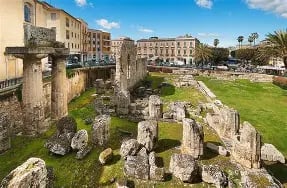
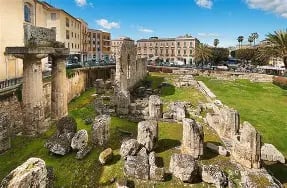
The Temple of Apollo on Ortigia, the historic heart of Syracuse, dates back to the early 6th century B.C. and is considered the oldest stone Doric temple in Sicily and one of the earliest monumental Greek stone temples in the Western Mediterranean.
It represents an architectural transition from wooden to stone construction, a major milestone in ancient Greek architecture.
An inscription carved on the top step on the eastern side dedicates the temple to Apollo, underscoring its original religious function.
The temple remains are located near Piazza Pancali and Largo XXV Luglio on Ortigia and are easily accessible while walking through the historic center.
You can see the remnants of the columns and the base, and nearby markets add to the lively atmosphere around this ancient site.
Piazza Archimede
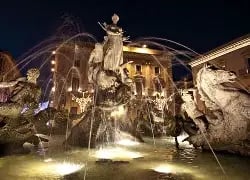
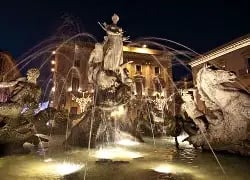
Piazza Archimede is one of the most beautiful and historically significant public squares in Siracusa, located on the Isola di Ortigia — the ancient heart of the city. It’s considered the second most important square in Ortigia after Piazza Duomo and has long been a central meeting place for both locals and visitors.
The square was opened in 1878 as a central public space in Ortigia, at a time when many historic buildings on the site had been removed or rebuilt.
It was dedicated to Archimedes (born in Syracuse around 287 B.C.), one of the greatest mathematicians and scientists of antiquity — a native son whose legacy is deeply tied to the city’s cultural identity.
Piazza Archimede became a hub of city life, where people gathered for socializing, public events, political debates, and everyday rendezvous.
Piazza Duomo
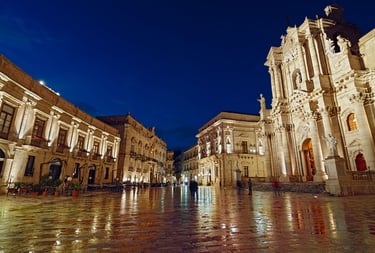
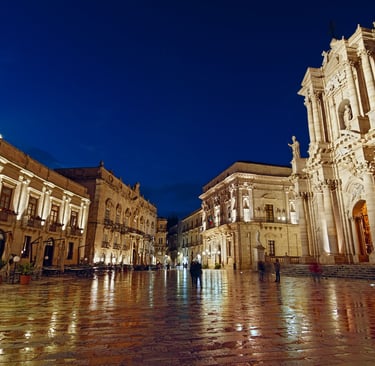
Piazza Duomo is the monumental and symbolic heart of Siracusa, located on the island of Ortigia. It’s one of those places that stops you in your tracks—bright, elegant, and layered with over 2,500 years of history.
Built on an Ancient Greek Temple
Dominating the square is the Duomo di Siracusa, one of the most extraordinary cathedrals in Europe. Why? Because it is literally built around the Temple of Athena from the 5th century BC.
The original Doric columns of the Greek temple are still visible along the sides and inside the church. This isn’t a replica—it’s the real structure, reused and transformed over centuries.
In one building, you’re seeing:
Greek temple → early Christian basilica → mosque → Norman cathedral → Baroque façadePiazza Duomo is perfectly framed by historic buildings that create a rare sense of balance:
Palazzo Beneventano del Bosco – one of the finest Baroque palaces in Sicily
Palazzo Arcivescovile (Archbishop’s Palace)
Church of Santa Lucia alla Badia, linked to Caravaggio and the cult of Saint Lucy
Fonte Aretusa
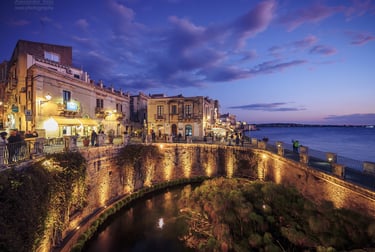
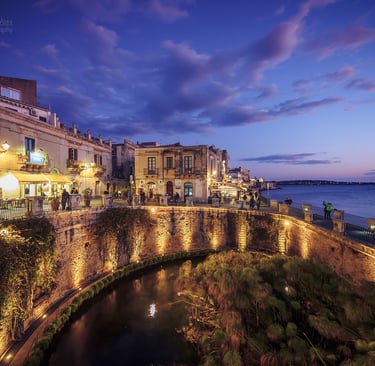
Fonte Aretusa is one of the most poetic and iconic places in Siracusa—a spot where myth, nature, and the sea come together in a way that feels almost unreal.
Fonte Aretusa is a natural freshwater spring located just a few steps from the Ionian Sea, on the western edge of Ortigia. Fresh water bubbling up right next to salt water is already rare—but this spring has been famous since ancient Greek times.
According to Greek mythology:
Aretusa, a nymph, fled from the river god Alpheus, who was pursuing her.
The goddess Artemis (Diana) transformed Aretusa into a spring to protect her.
Alpheus, not giving up, turned himself into a river that flowed underground from Greece to Sicily to reunite with her.
This myth explains why ancient Greeks believed the spring was mysteriously connected to rivers in mainland Greece—and why the site was considered sacred.
Castello Maniace
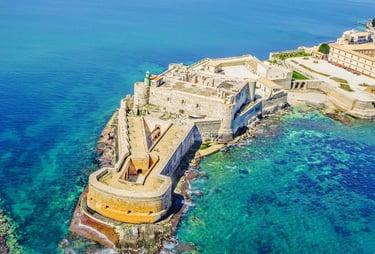
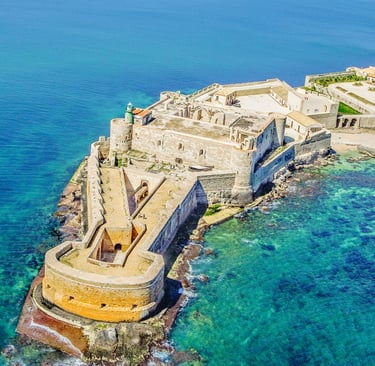
Castello Maniace stands at the very tip of Ortigia, where land ends and the Ionian Sea begins. It’s one of the most powerful and atmospheric landmarks in Siracusa—less decorative than Piazza Duomo, but deeply imposing and dramatic.
A Fortress at the Edge of the Sea
Castello Maniace was built between 1232 and 1240 by order of Frederick II, one of the most fascinating rulers of the Middle Ages.
Its purpose was clear: defend the harbor and control access to the city.The castle is named after Giorgio Maniace, a Byzantine general who reconquered Syracuse from Arab rule in the 11th century.
Its position allowed full control of the Porto Grande (Great Harbor), naval access to Ortigia and coastal defense against invasions.
For centuries, it was one of the strongest military points in southeastern Sicily.